
…And good riddance! The longest year in living memory is drawing to a close and it’s finally time to reflect on one positive thing that happened. It was the “Year of Magnolia Table,” and as the ball dropped (virtually) on 2020, so it did on this project! I feared accepting defeat due to the fact that there were simply no green tomatoes to be found in Colorado in December, but a Hail Mary, last-minute shopping trip provided the elusive ingredient, so I didn’t have to let myself off the proverbial hook. Not even 2020 could stand between me and my goal of successfully (and sometimes unsuccessfully) preparing all 139 recipes from Joanna Gaines’ inaugural cookbook! (Pats self on back, takes mental bow.)
So, what have I learned from this experience? In classic “Marie Kondo” fashion, does this knowledge come with me into the future as something which sparks joy, or do I leave it cheerfully in my wake? The answer is, not surprisingly, both. I found dishes to include in our regular rotation as well as ones that will never again darken my doorstep. If you are considering undertaking a cookbook odyssey of your own, please allow my experiences to inform your decision. After three visits to this particular rodeo, let me save you some heartache. And cash. Lots of cash… Let’s start with the last few recipes which dragged out forever, repeatedly foiling my attempts to wrap this project up weeks ago. (I really want to make something of the “foil” and “wrap” pun, but I’ll just leave it right here!)
Lesson 1: Cook your recipes IN SEASON!
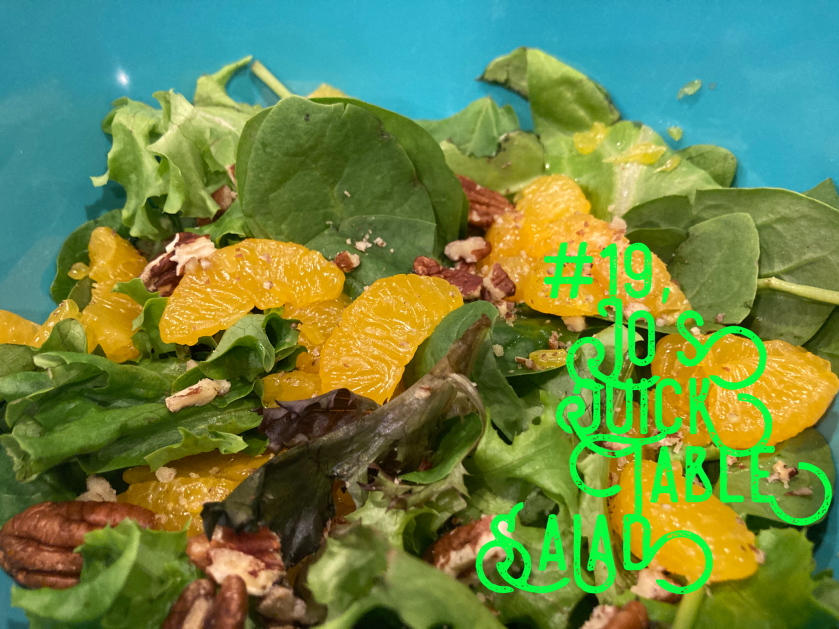
This seems obvious, but as we all know, life gets in the way, the best laid plans, yada, yada. Whatever excuse you throw at this lesson, it will do nothing but sit back and laugh at you while you scramble about, trying to locate the ingredients you need after procrastinating until “off-season”. I had a FULL GARDEN for crying out loud (who didn’t this year?!), yet I never got around to making Jo’s Quick Table Salad when I had the vegetables literally growing at my fingertips for “free”. Of course, as anyone with a garden knows, there are plenty of expenses that go along with the benefit of fresh veggies. Even the dirt costs money! So long story short, I wasted funds many times over by avoiding this uninspiring recipe (I don’t care for orange slices in salad, nor most vinaigrettes) until the dead of winter. I threw money down the drain once by failing to use my paid-for homegrown lettuces, and several more times by repeatedly purchasing store-bought bagged salad, which inevitably went into my crisper to die a slow, slimy death. I failed to adhere to Lesson 1 with the aforementioned Fried Green Tomatoes With Quick Remoulade. I had to make do with tomatoes which were riper than ideal, but it was my only option. That was a true embarrassment, since my abundant tomato crops literally handed firm, fresh, green tomatoes to me on a daily basis for weeks! In the end, cooking recipes off-season means being forced to use subpar ingredients, and potentially robbing yourself of the chance for a new dish to impress you.
Lesson #2 Deep fry at your own peril… but check that oil temp!
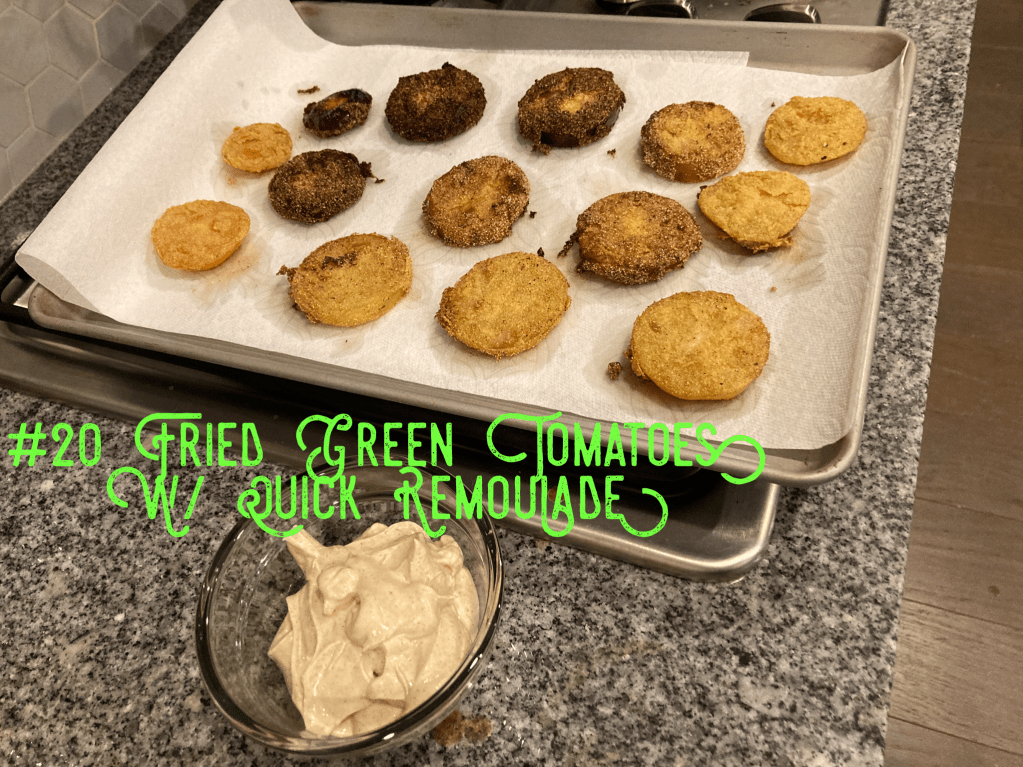
As the photographic evidence suggests, deep fat frying is not my forte. Whether it’s donuts or chicken, tomatoes or tortillas, I hate doing it. I do excel at eating fried foods; Colonel Sanders, your business is safe with me! This last round with the hot oil ended in much the same way as other recipes this year: temperature way too high in the beginning, then dropping way too low by the end of the batch, with too much breading falling off in between. You can follow the path of my exact order of frying the mostly-green-but-not-completely-unripe tomatoes from the level of “charcoal” to “anemic” coloring. At no point did I quite hit the sweet spot of “golden brown”, despite my best efforts. Two pointers to help the novice fryer: use a candy thermometer, and choose the right oil for the job. Using a candy thermometer can stop you from frying too cold (turning your food into oil sponges), or letting it get too scorching hot (turning food to blackened hockey pucks), but beware taking the temp in the wrong place. If the thermometer touches the bottom of the pan or is raised up too high, your reading will be wildly off! Unless you have an allergy, I found frying in peanut oil to be the most forgiving. The smoke point is 450 degrees, so you won’t risk flashover fires or accidentally filling the house with smelly smoke, a real concern if you fry in olive oil or butter (smoke points of 320 and 302 degrees respectively). Vegetable oil almost as good, coming in with a smoke point of 428, but I find the flavor lackluster. Regardless of my dubious skill in the field of frying, the tomatoes turned out tastier than expected. If they had been truly green through and through, the lower water content surely would have produced an even better result. Refer to Lesson 1 for how to fix this…

Lesson 3: Brush up on multiplying and dividing your recipe yields!
It happens almost every time. I flip to a new page in my cookbook, see a scrumptious-looking plate of (cake, veggies, roast beef, etc.) and start gathering ingredients, gleefully anticipating my next meal. Often I’m halfway through mixing the batter or marinade or what-have-you when I spot the problem: “Yield-12 servings”. Well, crap. There are only three people in my day-to-day household, and they’d generally prefer not to eat “Groundhog Day” style for a week. Doubling a recipe is pretty easy even if you don’t do any math at all; just repeat each ingredient amount twice. The challenge comes when you halve or quarter a recipe. What’s one fourth of 1 and 2/3 cups?? I lived this nightmare in high school, don’t make me go back there! There are two ways I tackle this problem when I catch it in time… or when I just don’t expect to enjoy the results! Stuffed Bell Peppers, yield 4? I think not. I’m making ONE, and only taking a single obligatory bite before pitching it in the trash or “graciously offering” it to someone else. One solution for avoiding a gallon of soup or meatloaf for 10 is to only concern yourself with the wet/dry ratios, and eyeball the supporting characters to taste. For example, make sure you divide the flour/milk/broth measurements exactly so the mixture comes together correctly, but you can often fudge on things like how much cinnamon or cheese or how many chocolate chips to stir in. (Preferably not all those in the same recipe…) For more precise division, put your faith in the trusty kitchen scale. If you weigh the full amount, then pull back until you reach exactly half the ounces, you can be sure the ratios will all be accurate. I wish I’d employed that technique in the above recipe, Chocolate-Orange Bread Pudding, because while we shockingly all seemed to enjoy it well enough, it just made too darn much. Also, I failed to use the required one pound of bread, yet proceeded to make the full quantity of egg/cream mixture, resulting in a veritable lake of liquid. By estimating how much fluid to pour off, I managed to avoid a soggy mess…but it was a waste of those precious eggs, and whipping cream ain’t cheap!

Lesson 4: Get creative with your leftovers!
If you failed to heed Lesson 3 and ended up with six quarts of recipe #132, Party Queso for instance, you’ll need to repurpose some of that product or kiss your hard-earned money goodbye when you grow weary of eating it in its original form. I made this dip for a small party a few weeks back and didn’t question the proportions until I saw just how full the pot was. Then I panicked. A crowd size not seen since pre-Covid days was necessary to chow through it all, and needless to say, our small gathering did not justify that much Velveeta. The solution is to put the cookbook away and look at what you have through a different creative lens. On a recent episode of “Pioneer Woman” (shout-out to my girl Ree!) she used up leftover frittata by slicing the cooked egg into a square chunk and placing it between two English muffin halves with some cheese. Instant breakfast sandwich! The same concept applied when we took the “dip” and turned it into a topping for individual nacho bowls, complete with leftover pickled jalapeños from another erstwhile recipe. Similarly, I made enough remoulade to accompany the Fried Green Tomatoes to sink a battleship (even with cutting the recipe in half!), so instead of trashing the excess, I’ve used it successfully as a mayo substitute for deviled eggs and chicken salad. Today it might become the spread in a turkey sandwich. The possibilities are nearly endless if you use your imagination!

Lesson 5: Let yourself be amazed!
I can be a judgmental jerk in the kitchen. Certain ingredients always “trigger” me into believing that I will not enjoy a particular recipe, and I struggle every time with sampling the food with an open mind. Take the Chicken Spaghetti recipe, which included two kinds of peppers (gag) and mushrooms (my daughter turns up her nose at all fungi). Nonetheless, the entire family devoured this dish with nary a complaint! It’s a lesson I have to remind myself of repeatedly, but if you let yourself be open to a flavor experience, you just might discover a new family favorite hiding in “overly picky” clothing.
January, 2021 has now arrived and with it comes exciting prospects for my next cookbook journey. I’m looking forward to celebrating the completion of Magnolia Table with a trip to Magnolia Farms in Waco once this pandemic is behind us, and selecting a new kitchen experiment to share with you. Happy New Year, and I can’t wait for you to join me on the next adventure!
 Have Book, Will Cook